


Data-driven introduction
The decision to automate a blade battery assembly line must begin with measurable questions: what is current throughput, where do defects cluster, and which downtime categories consume available production minutes? A data-first review frames sensor placement, control logic, and layout changes. I draw on five years editing technical automation studies and comparative production audits to structure the evidence below, with a single, familiar industry reference point: CATL’s 2020 unveiling of the blade battery format—an event that prompted many integrators to re-evaluate conveyor geometry and in-line inspection strategies.

Key metrics for evaluation
Choose objective, repeatable metrics and collect baseline values before design. Essential metrics include:- Throughput (units per hour) measured over a full shift.- Mean time between stoppages (MTBS) and mean time to recover (MTTR).- Inline defect rate (parts per million) after each processing station.- Electrical energy consumption per production unit.- Traceability completeness (percentage of units with full serial and process data).Track these metrics continuously. Decisions about motor sizing, sensor redundancy, or indexing versus continuous flow must be justified by changes in these numbers rather than by vendor claims.
Core features that deliver measurable gains
Design requirements should map directly to the metrics above. Prioritize:- Modular belt segments or slat conveyors sized to the blade cell footprint to reduce misalignment.- Servo-driven indexing with closed-loop position feedback when cell placement tolerance is tight.- Distributed sensors (vision, laser triangulation, RFID) that feed a central MES for traceability and root-cause correlation.- Integrated safety zones with predictive stop logic to reduce MTTR while preserving throughput.- Energy recovery and demand-based motor control to lower energy per unit.Each feature exists to change one or more metrics. For instance, replacing open-loop with closed-loop indexing commonly reduces misfeeds; vision-based presence checks reduce downstream rework by intercepting defects immediately.
How these systems apply on blade battery lines
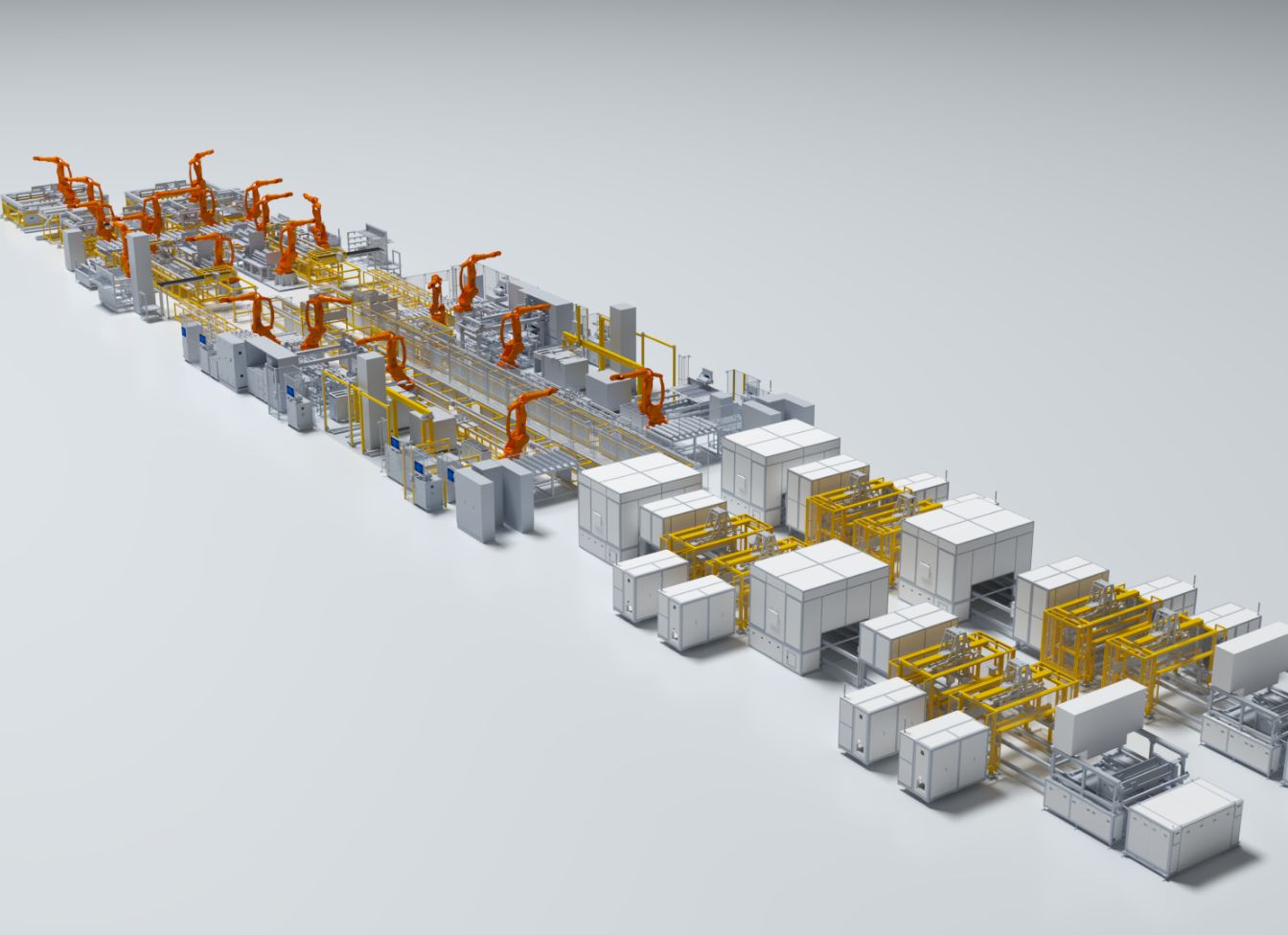
Blade cells are long, thin, and sensitive to handling. That physical reality alters conveyor choices:- Narrow, supported span conveyors prevent cell sag and reduce contact points.- Low-vibration motors and soft-start profiles lower mechanical stress during transfer.- Inline hot-spot or surface-inspection cameras positioned at known fixed intervals to detect coating defects or burrs.- Synchronised transfer modules to move cells from coating, drying, and assembly without manual reorientation.When describing the automation architecture, use explicit mapping: station → sensor suite → control outputs → expected metric improvement. This clarity shortens commissioning time and focuses testing protocols.
Control layers and data flow
Structure control as three layers:1. Device layer: motors, encoders, sensors, and safety controllers.2. Cell/line control: PLC logic for sequencing, coordinated motion, and local error handling.3. Integration layer: MES/SCADA for traceability, analytics, and production reporting.Ensure timestamps and unique unit identifiers persist across layers. The integration layer should export standardized event streams for analytics and for external audits of the blade battery manufacturing automation process. Reliable time-series and event data enable the data-driven decisions discussed earlier.
Performance validation and testing protocol
Define acceptance tests with clear pass/fail criteria tied to the core metrics:- Run a cold start test to collect MTTR and sensor false-positive rates.- Conduct a continuous run at design throughput to verify thermal and vibration stability.- Introduce seeded defects to validate inspection sensitivity without affecting real product.Log results, compute confidence intervals for defect detection, and require corrective actions when targets are missed. Validation reduces finger-pointing during ramp-up and shortens the path to stable production.
Common pitfalls and how to avoid them
Practical failures are rarely technical surprises. Common errors:- Over-specifying sensors without defining decision thresholds — leads to noise and spurious stoppages.- Ignoring mechanical support for long cells — leads to cumulative alignment drift.- Delaying MES integration until after commissioning — costs time and obscures traceability.Prevent these by forcing metric-based acceptance criteria at each procurement or design decision. Keep mechanical, electrical, and software teams aligned on the same numeric targets.
Comparative insight: modular conveyors versus bespoke lines
Modular conveyors win on speed of deployment and predictable behavior for standard cells. Bespoke lines win when cell geometry or process steps are novel. Choose modular when:- Production volume is medium to high with stable product geometry.- Short lead-time to market is required.Choose bespoke when:- Process steps require unique kinematics or custom inspection angles.- Mechanical constraints (e.g., extreme temperatures or unique coating processes) demand special materials.Record the trade-offs quantitatively: cost per unit at ramp, projected uptime, and expected time to first-pass yield targets.
Practical checklist for procurement and commissioning
Use this checklist during procurement:- Define metric baselines and target improvements.- Require standardized data exports and timestamped event logs.- Specify maintenance access and modular replacement timelines.- Mandate a phased acceptance plan with seeded-defect tests.During commissioning, record all deviations and resolve them before full-rate production. This disciplined approach preserves schedule and reduces ambiguity.
Final synthesis
Data-focused decisions reduce speculation. When conveyor geometry, sensor suites, and control hierarchies are chosen to change specific metrics, commissioning proceeds faster and defects fall sooner. My editorial work with automation teams shows that measurable goals, tight validation protocols, and careful mechanical design converge to stable blade battery output—practical guidance consistent with established industry analysis and the technical references shared by FHS.