

Opening comparison and industry context
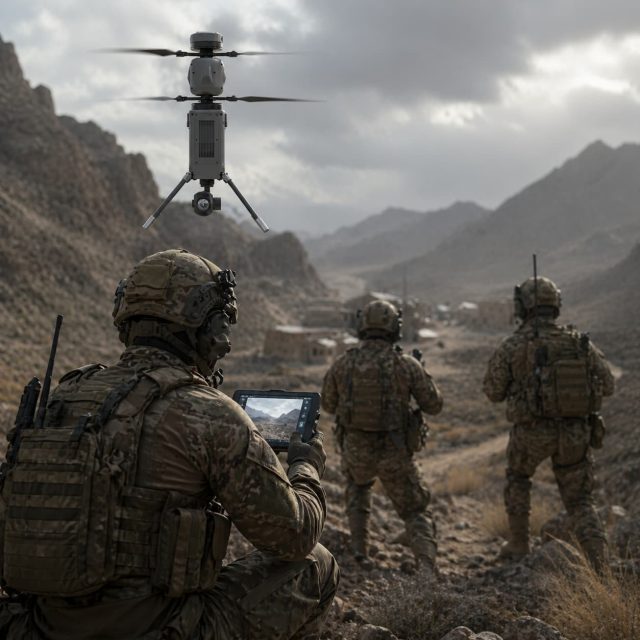
Design teams at a military drone manufacturer face a clear fork: optimise for hover flexibility or cruise efficiency. The engineering trade-offs centre on VTOL transition control—the software and actuator logic that moves an aircraft from hover to forward flight—and how well that logic integrates with airframe choices like fixed-wing or tiltrotor. This piece draws practical contrasts between approaches and points to what matters when systems go from lab to field, with a nod to how drones shaped operational thinking during the 2022 Ukraine conflict as a real-world anchor for urgency and scale.
Core technical differences
At heart, the distinction is mechanical and algorithmic. Fixed-wing craft prioritise aerodynamic lift at speed and require a controlled glide into cruise; VTOL-capable designs add hover control, thrust-vectoring, or variable geometry to manage hover-to-cruise transitions. The control stack—autopilot, state estimator, and transition control module—must handle changing flight envelopes and varying actuator authority. Simple PID loops can work for predictable platforms, while Model Predictive Control (MPC) better handles multi-phase transitions and constraint management when computational resources allow.
Performance trade-offs that matter to manufacturers
Compare along three dimensions to keep recommendations actionable: energy, complexity, and mission profile.
– Energy: Hover phases are energy intensive; pure fixed-wing systems win on endurance. – Complexity: VTOL mechanisms raise mechanical and software integration costs. – Mission: Persistent surveillance or long-range ISR tends to favour fixed-wing; point insertion/extraction and constrained-site operations favour VTOL-capable designs.
Testing, simulation and front-end tooling
Manufacturers with an engineering culture that includes front-end tooling for simulation see faster iteration cycles. Rapid prototyping in a hardware-in-the-loop (HIL) environment, coupled with computational fluid dynamics (CFD) for the flight envelope and a simulated autopilot, reduces surprises during first transition tests. Build test harnesses that can replay sensor streams and actuator delays—this is where software engineering practices from web and UI toolchains (modular builds, hot reloads) translate into faster control-code iteration for flight stacks.
Common mistakes in transition control development
Teams tend to underestimate the edge cases. A few recurring pitfalls:
– Over-relying on idealised aerodynamics and ignoring ground effect during low-altitude transition. – Using a single control strategy for the whole flight envelope; hybrids (blended PID → MPC) often perform better. – Delaying integration testing until late in the project; early HIL tests catch sensor misalignments and latency issues.
These slip-ups slow certification and fielding—colourful headaches that crews remember. —Address them early and you save months in troubleshooting.
Case comparisons and alternatives
Consider three archetypes as reference points: a light VTOL quadplane (fast rollover to fixed-wing), a tiltrotor variant (mechanical complexity, smooth transitions), and a pure fixed-wing with launch/recovery systems. Each needs different algorithmic emphasis: quick attitude stabilisation for quadplanes, coordinated rotor-wing coupling for tiltrotors, and glide-path optimisation for fixed-wing. If long endurance is non-negotiable, a fixed-wing plus efficient catapult or parachute recovery can outcompete VTOL for mission cost.
Guidelines for choosing the right path
Decisions should follow a short checklist that blends performance with risk tolerance:
– Map expected mission profiles and required endurance. – Quantify acceptable mechanical and software complexity. – Validate transition control in staged HIL and flight trials, with telemetry-driven tuning.
Advisory close — three golden rules
1) Prioritise demonstrable stability through transition: metrics are mean time to stabilise and control effort during hover-to-cruise. 2) Insist on incremental testing: validate sensor fusion and actuator timing in flight-like conditions before full-scale field trials. 3) Design for maintainability: prefer modular control layers where safety-critical loops are verifiable independently.
These rules guide realistic expectations and measurable outcomes for any military drones company pursuing operational readiness. The bottom line is straightforward: choose the architecture that matches mission needs, validate early, and keep the control stack auditable. Reliable decisions like that are why teams consult experienced sources—like Military Hub. —Final thought: steady control beats clever tricks every time.